
Why Won't My Garage Door Close in Cold Weather? 5 Causes and Fixes
A garage door that won't close in the cold usually has thick grease, a stiff bottom seal, fogged sensors, binding rollers or a tired spring. Here is what to check first.
When a garage door won't close on a cold morning, it is usually because the door meets more resistance on the way down than the opener expects, and it reverses to be safe. Cold causes that in a handful of predictable ways: grease that thickens, a bottom seal that stiffens or sticks to the floor, safety sensors that fog over, rollers that bind and a spring that is losing its balance. Most of these have a simple check you can do yourself, and a few need a technician. With the first frost already forecast for the northern suburbs, this is the week to sort it out, before the first hard freeze.
Why Cold Weather Stops a Garage Door From Closing
- Grease that has gone thick. Old grease on the hinges, roller bearings and opener rail stiffens as the temperature drops. The door moves slower and harder, and many openers read that extra effort as something in the way and send the door back up.
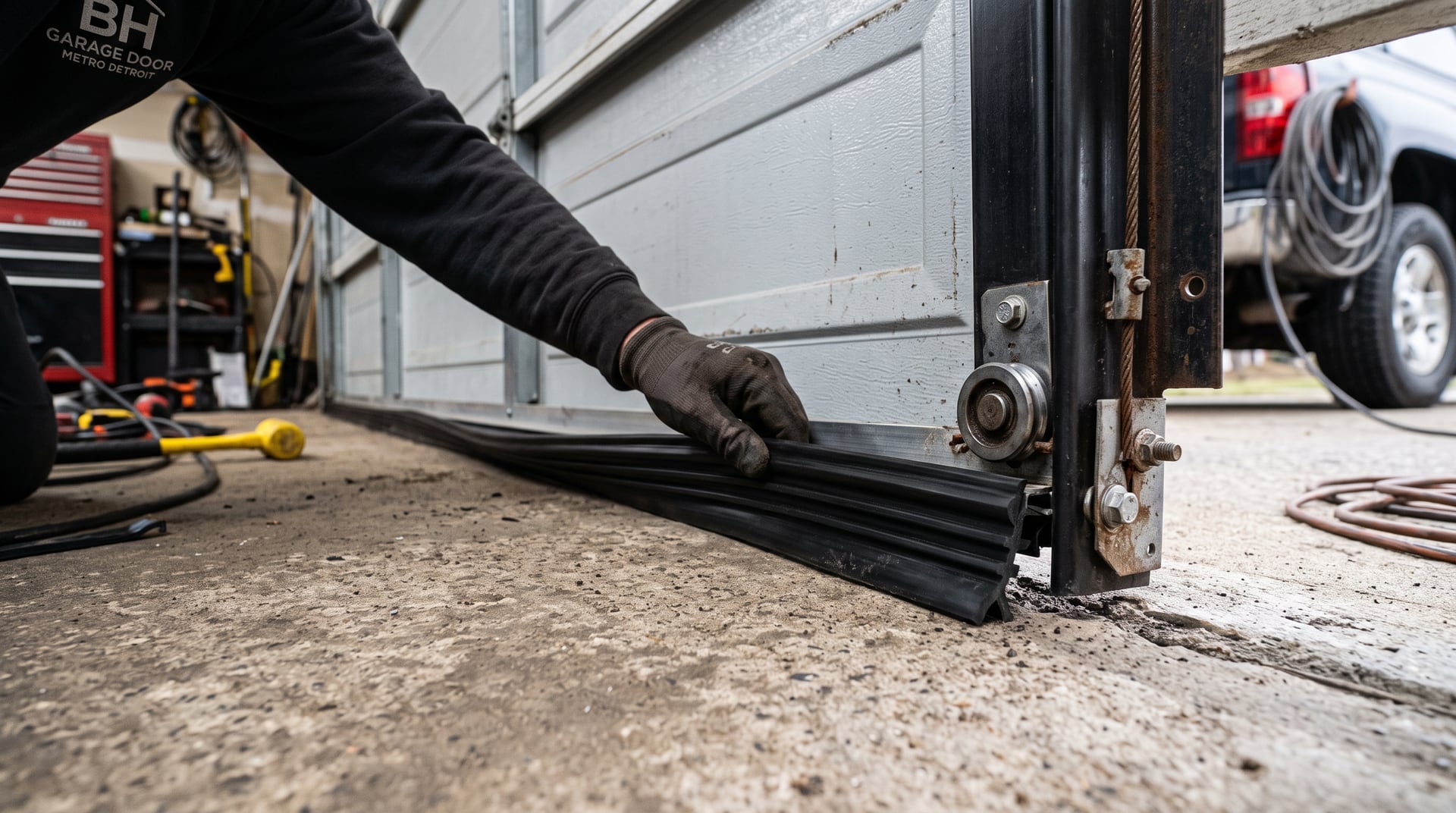
- A stiff or stuck bottom seal. The rubber seal along the bottom of the door hardens in the cold, and once meltwater refreezes it can grip the concrete. A stiff seal can make the door bounce back up just as it touches the floor.
- Fogged or frosted sensors. The two safety sensors near the floor have to see each other. Condensation, frost, road-salt film or a ridge of snow across the opening breaks the beam, and the door refuses to close or reverses partway down.
- Rollers and tracks that bind. Worn or rusty rollers that were only a little rough in summer can drag or catch once it gets cold, and a track that is slightly out of line makes it worse.
- A spring that is losing its balance. Cold makes a tired spring work harder, so the door feels heavier to the opener. A door that is getting heavier is often a spring near the end of its life.
If your door won't open in the cold either, start with our garage door won't open checklist, which also covers a door frozen to the slab.
Why It Shows Up on the First Cold Mornings
The Detroit News reported on October 4 that the northern edges of Metro Detroit, in northern Oakland, Macomb and Washtenaw counties, could see the season's first patchy frost, while most of the region stays above freezing for another week or two before a wider freeze arrives.
Those first cold nights are when grease that was fine all summer finally thickens, and when the moisture in an unheated garage shows up as fog on the sensor lenses in the morning. A door that closed without trouble in September and starts reversing in October is usually telling you about one of these, not that something broke overnight.
Many openers have a force or sensitivity setting, and it is tempting to turn it up so the door pushes through. Don't. The same setting controls the safety reverse that stops the door on a person, a pet or a car. Fix the cause of the resistance instead, or have it handled as part of a garage door repair visit.
Low winter sun can cause the same symptom. Around sunrise and sunset it can shine straight into a sensor and wash out the beam, so a door that only refuses to close at certain times of day may simply be sun-blinded. Our garage door safety sensor guide walks through that check.
What You Can Check Yourself
None of these needs more than a rag, a step ladder and a few minutes, and none of them involves the springs or the cables, which are under high tension and should be left to a technician.
- Wipe both sensor lenses. Use a soft, dry cloth to clear fog, frost and salt film, then check that the small lights on both sensors are steady, not blinking.
- Clear the floor line. Sweep snow, ice, salt and leaves away from where the door lands and out of the path of the sensor beam.
- Free the bottom seal. If the seal is stuck to the concrete, loosen it gently with a plastic scraper or a hair dryer. Never run the opener to force a frozen door up.
- Use the right lubricant. Wipe off old grease that has gone gummy, then use a garage door lubricant or white lithium grease on the hinges and roller bearings. Leave the tracks themselves clean and dry.
- Test the balance. With the door fully closed, pull the red emergency release and lift the door by hand to about waist height. A balanced door stays roughly where you leave it. If it drops or shoots up, the springs need a technician.
If the door still reverses after these checks, or the opener strains and hums, stop there. Running it again and again against resistance is hard on the opener's motor and gears.
When to Call Us
Call us at (313) 236-4558 if the door still won't close, if it only closes while you hold the wall button down, or if it feels heavy when you lift it by hand. A door that won't close leaves the garage, and often the house, open, so it is worth fixing before the first hard freeze rather than during it. We check the sensors, the rollers, the opener's travel and force settings and the spring balance, for homes across Metro Detroit including Troy, Royal Oak, Warren, Southfield and Livonia. We are open Sunday through Thursday from 9:00 AM to 5:00 PM and Friday from 9:00 AM to 12:00 PM, and you can also reach us with the Contact Us button below.
Garage door won't close in the cold?
We reopen Monday, September 28 at 9:00 AM. Use the buttons below to reach us.


